
World of Tanks for beginners: how the game really works
Advertising disclosure. This page contains partner (affiliate) links, each marked “Partner link”. If you follow one and register or make a purchase, toridon.online, operated by DEKLEON s.r.o., may earn a commission. It costs you nothing extra and does not change our assessment.
toridon.online is an independent publication. It is not affiliated with, endorsed by or sponsored by Wargaming or World of Tanks. How we are funded.
World of Tanks is a free-to-play online game in which two teams of armoured vehicles fight short battles on fixed maps. It is easy to download and hard to master. This guide explains how it actually works so you can decide whether it is for you, and avoid the mistakes most new players make.
Key facts at a glance
- Developer and publisher: Wargaming.
- First released: 2010 in Russia; 2011 in Europe and North America.
- Price: free to play, with optional purchases.
- Platform covered here: the PC client for Windows. The console game (World of Tanks Modern Armor) and the mobile game (World of Tanks Blitz) are separate products with their own progression.
- Battle format: Random Battles of up to 15 players per team, normally lasting up to 15 minutes.
- Account: you need a free Wargaming account to play.
Details such as game modes, vehicles and prices change with updates. Where this guide and Wargaming's official information differ, the official information prevails.
What World of Tanks is (and what it isn't)
World of Tanks is a team-based online action game. You pick one vehicle from your “garage”, join a battle, and work with up to 14 teammates to beat the other team. Battles are self-contained: when your vehicle is destroyed you do not respawn, and nothing you do in one battle carries over into the next except the experience and in-game money you earned.
The vehicles are based on armoured fighting vehicles from roughly the interwar years to the early Cold War, including many prototypes and designs that were only ever drawn on paper. The game models armour thickness, angles and gun penetration in some detail, but it is an arcade-leaning action game, not a military simulator: handling, damage and visibility are deliberately simplified for balance and pace. If historical realism is your main interest, treat the game as inspired by history rather than a faithful recreation of it.
The game is free to download and play. Wargaming makes money from optional purchases such as a time-limited premium account, premium vehicles and in-game gold. We look at what these do, and whether you need them, further down.
Partner link: if you register or make a purchase after clicking it, toridon.online may earn a commission. It costs you nothing extra and does not affect what we write.
How a battle works
In the most common mode, a Standard battle in Random Battles, each team starts near its own base. A team wins by either destroying every enemy vehicle or capturing the enemy base, which means keeping vehicles inside the base circle long enough to fill the capture bar. Damaging a vehicle that is capturing resets or slows its progress. If the timer runs out with neither condition met, the battle is a draw.
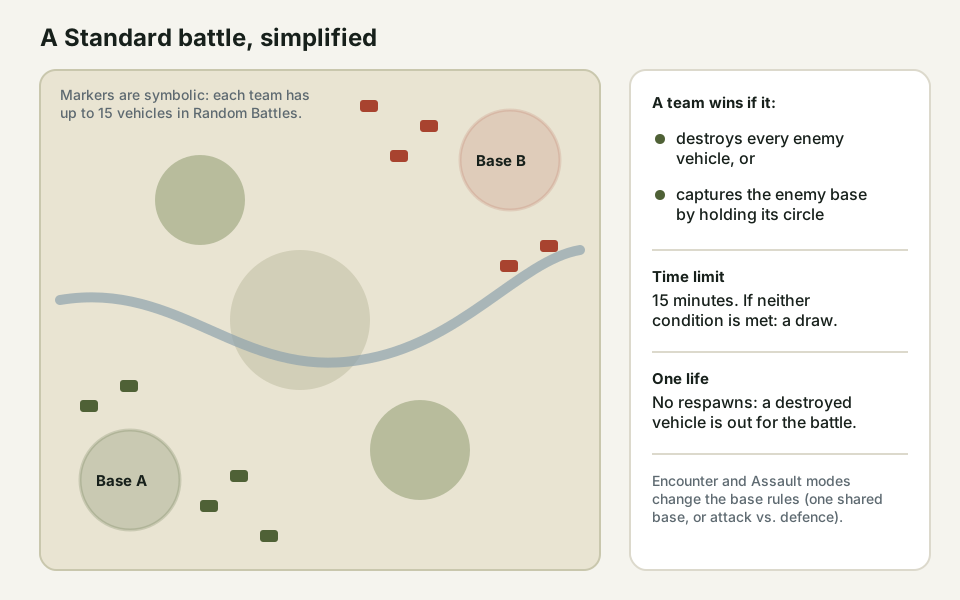
Two other Random Battle modes change the base rules. In Encounter, both teams fight over a single neutral base. In Assault, one team defends a base and the other attacks. On top of these, Wargaming regularly runs time-limited modes and events, and competitive modes come and go between seasons, so check the game client for what is currently available.
Because you only get one life per battle, patience matters more than in most shooters. Rushing forward alone usually ends in being destroyed in the first minutes, which costs your team a vehicle and costs you a slice of your rewards.
Vehicle classes in one minute
Every vehicle belongs to one of five classes. Each has a job, and a team usually does best when the classes support each other.
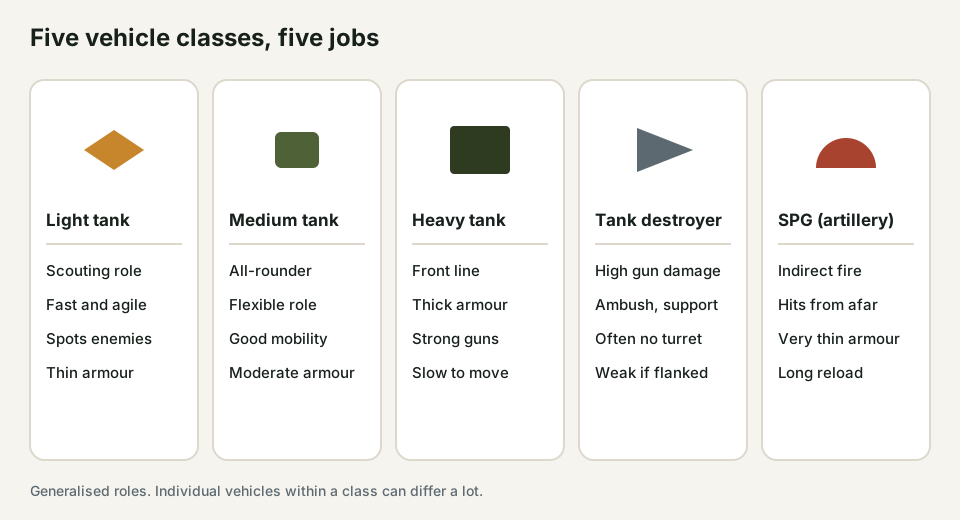
- Light tanks are fast and lightly armoured. Their main job is spotting: finding enemies so the rest of the team can shoot them.
- Medium tanks are all-rounders that can fight, support and move to wherever the battle is being decided.
- Heavy tanks have thick armour and strong guns. They hold and push the main lines.
- Tank destroyers usually trade armour or a rotating turret for high gun damage and good concealment.
- Self-propelled guns (SPGs, “artillery”) fire in an arc from far behind the front line, relying on teammates to spot targets.
We explain each class, its strengths and the typical beginner mistakes in our separate guide: World of Tanks vehicle classes explained.
Tiers, tech trees and matchmaking
Vehicles are grouped into tiers. The higher the tier, the stronger and more expensive the vehicle tends to be; historically the scale ran from tier I to tier X, and Wargaming adjusts the structure from time to time. Vehicles are organised by nation into tech trees. The PC game currently includes trees for more than ten nations, with several hundred vehicles in total.
You research your way along a tree: experience earned in a vehicle unlocks its better modules (guns, engines, turrets, suspensions, radios) and eventually the next vehicle. You then buy that vehicle with credits, the in-game currency you earn by playing.
Matchmaking in Random Battles puts vehicles into teams mainly by tier and class, aiming for two teams of comparable composition. It does not match players by individual skill. As a new player you will therefore meet experienced players from your first battles, and a battle can include vehicles up to two tiers apart, so sometimes you will be among the weakest vehicles on the field. Knowing this helps: when you are bottom tier, play a supporting role rather than leading the push.
Armour, penetration and ammunition
When you fire, your shell has a penetration value in millimetres. If it beats the armour where it hits, it penetrates and does damage; if not, it does no damage (high-explosive shells are an exception, see below). Two things make this more interesting than comparing two numbers.
First, angles matter. A plate that is sloped relative to the incoming shell presents a longer path of steel. The same 100 mm plate behaves roughly like 141 mm at 45° and like 200 mm at 60°. Angling your vehicle slightly to the enemy is therefore one of the most useful habits to learn, and so is aiming at flat, thin areas of the enemy.
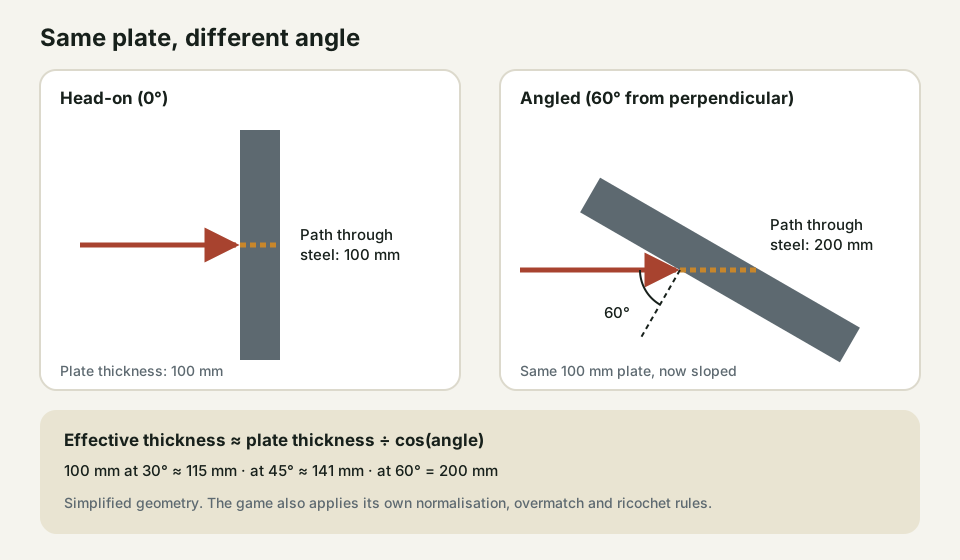
Second, the game adds its own rules. Shells that hit at very shallow angles can ricochet. Armour-piercing shells are slightly “normalised”, meaning turned towards the plate, when they hit. A gun whose calibre is far larger than the armour it hits (roughly three times or more) can “overmatch” it and ignore much of the angle. Finally, both penetration and damage vary randomly by up to about 25% either side of the listed value, so the same shot will not always produce the same result.
The four ammunition types
| Type | Strengths | Weaknesses |
|---|---|---|
| AP (armour-piercing) | Standard round on most guns; reliable; good against angled armour thanks to normalisation. | Can ricochet at shallow angles. |
| APCR (armour-piercing composite rigid) | Higher penetration and very fast shell. | Penetration drops over distance; less normalisation. |
| HE (high-explosive) | Can do some damage even without penetrating; damages modules and crew. | Very low penetration; damage absorbed by thick armour and spaced armour. |
| HEAT (high-explosive anti-tank) | High penetration that does not drop with distance. | No normalisation; stopped by spaced armour, tracks and screens. |
Many guns can fire a higher-penetration “premium” round in addition to their standard round. These can be bought with credits, so they are not limited to paying players, but they cost more per shot.
Spotting and camouflage
You can only aim at what your team can see. Each vehicle has a view range, how far its crew can detect enemies, and a camouflage value, how hard it is to detect. Bushes and trees improve your camouflage; moving and especially firing make you easier to see. Anything one teammate spots is shown to the whole team.
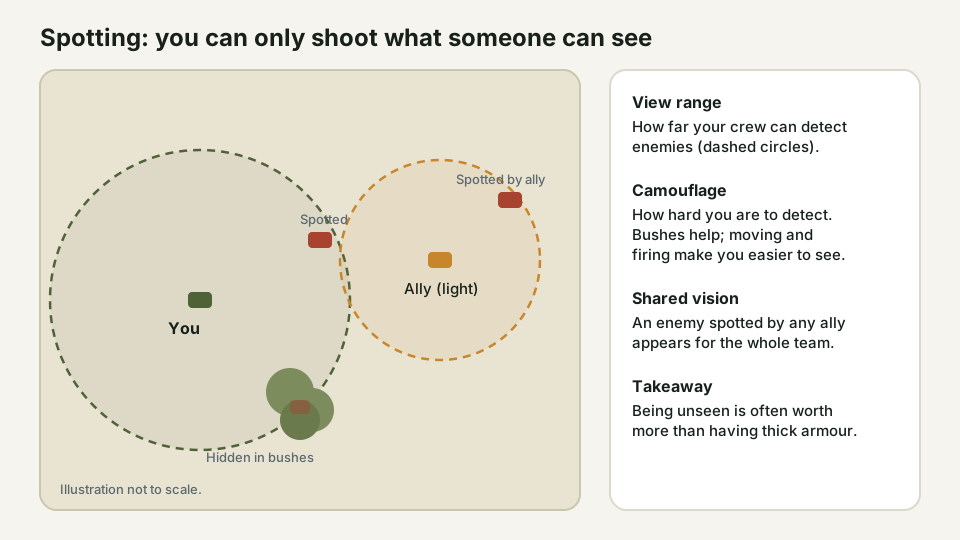
In practice this means that being unseen is often worth more than thick armour. Most tank destroyers and many light and medium tanks depend on it. If you fire from a bush while the enemy is close, you will often be spotted; pulling back after a shot, or waiting for a teammate to spot targets, keeps you alive longer.
Crew, equipment and consumables
Each vehicle has a crew, such as a commander, gunner, driver, radio operator and loader, depending on the vehicle. Crew members gain experience and learn skills that improve the vehicle's performance. Wargaming has reworked the crew system in recent years, so older guides and videos may describe skills that no longer exist in the same form.
Equipment is fitted into a limited number of slots and improves specific characteristics, for example reload speed, view range or concealment. Consumables are single-use or cooldown items taken into battle; the classic trio is a repair kit for damaged modules, a first-aid kit for injured crew and a fire extinguisher.
Credits, gold, free XP and premium: the free-to-play economy
Understanding the currencies helps you decide whether to spend anything at all.
| Resource | How you get it | What it is used for |
|---|---|---|
| Experience (XP) | Earned per vehicle in every battle. | Researching that vehicle's modules and the next vehicles in the tree. |
| Free experience | A small share of the XP from every battle. | Can be spent on research for any vehicle. |
| Credits | Earned in battle and from missions. | Buying vehicles, modules, equipment and ammunition; paying for repairs. |
| Gold | Mainly bought with real money; small amounts are sometimes available through missions and events. | Premium account time, premium vehicles, garage slots, certain conversions and services. |
| Premium account | Bought with gold or real money for a period of time. | Increases the XP and credits you earn while it is active. |
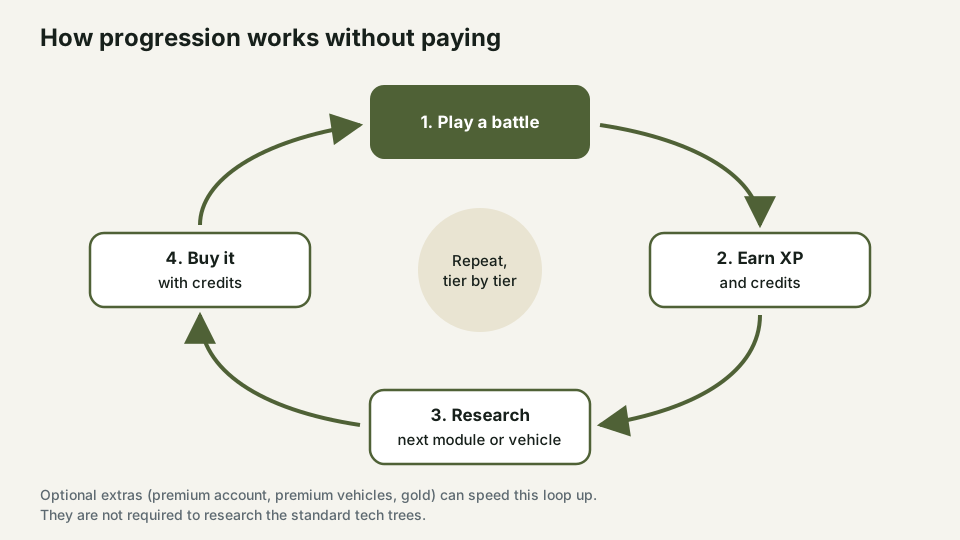
Do you have to pay? No. You can research and buy every vehicle in the standard tech trees without spending money. Paying mainly saves time, because a premium account and premium vehicles earn more. Premium vehicles are generally designed to earn credits rather than to outperform comparable standard vehicles, but whether the game is “pay to win” is a long-running debate among players, and we do not think it can be settled with a single claim.
If you do spend: set a monthly budget before you start, read exactly what a bundle includes, and be aware that some events in some regions sell randomised containers whose contents you do not know in advance. Parents may want to use platform and payment-method spending controls.
Partner link: if you register or make a purchase after clicking it, toridon.online may earn a commission. It costs you nothing extra and does not affect what we write.
Your first ten hours: a practical plan
- Do the in-game training first. It covers controls and basic mechanics against bots, and it costs you nothing.
- Try several classes at low tiers. Low tiers are cheap to play and quick to research. You will find out whether you prefer scouting, brawling or sniping before investing time in one tree.
- Learn a handful of maps. Every map has typical routes, firing positions and bushes. Watching where experienced players go in the first minute teaches a lot.
- Watch the minimap. Glancing at it every few seconds tells you where the enemy is, where your team is thin, and when you are about to be surrounded.
- Don't sit in the open. Use hard cover (rocks, buildings, ridges) to break line of sight, and only show yourself to shoot.
- Angle your armour and aim at weak spots. Avoid facing enemies flat-on, and learn where common vehicles are thin: lower front plates, sides, hatches and cupolas.
- Keep a mix of ammunition. Carry some of each type your gun can fire, so you can deal with thick armour or finish off weakened targets.
- Don't chase damage at all costs. Staying alive in the late game often wins more battles than one risky shot early on.
- Play in a platoon. Playing with one or two friends in voice chat makes the game more fun and the learning curve gentler.
- Take breaks. Losing streaks happen in every team game. A short break helps more than “one more battle”.
Who will enjoy it, and who probably won't
You'll probably like it if…
- you enjoy slower, tactical team battles where positioning beats reflexes;
- you like learning systems (armour, spotting, research trees) in depth;
- you want a free game you can play in sessions of about ten minutes;
- you are interested in armoured vehicles and their design history.
It may not be for you if…
- you want a strict military simulation;
- you dislike playing against much more experienced opponents early on;
- randomness in damage and penetration frustrates you;
- you don't want any in-game shop at all, even an optional one.
Getting started safely
Download the game only from Wargaming's official website or from a store the official website points to. Check the current system requirements there before downloading, as the client is large and requirements change with graphics updates. Never share your account password, and be wary of websites offering “free gold” or account generators: these are a common way of stealing accounts.
How this guide is funded
toridon.online is funded by commissions from partner links. When you click a button marked “Partner link”, you pass through our redirect page and a partner network to the official game website. If you then register or make a purchase, the partner may pay us a commission. The price you pay is the same, and our pages store nothing on your device.
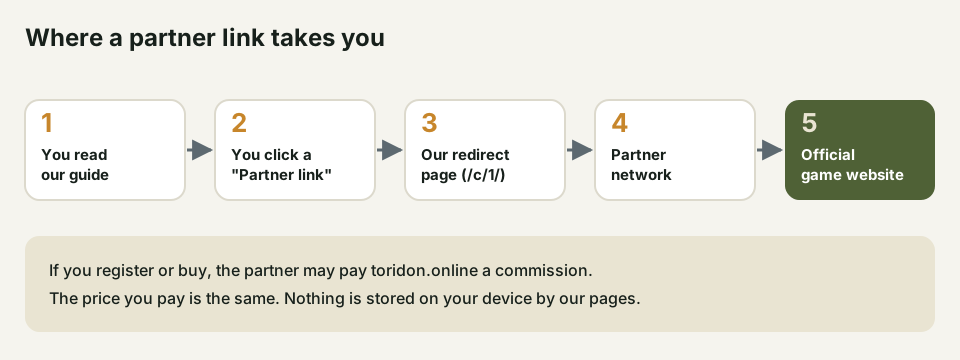
No advertiser reviews or approves our articles before publication. Read more in our editorial policy.
Corrections to this page
This page replaces an earlier, shorter promotional version. On 6 October 2026 we corrected or removed the following claims, which were inaccurate or could not be verified:
- “Over 100 different tanks” and “over 100 tanks and 20 maps”: the game has several hundred vehicles and its map pool changes over time. We now describe these without inventing exact figures.
- “Over 30 million players worldwide” / “30 Million+”: we could not verify a current active-player figure from an official source, so we no longer quote one.
- Platforms “PC, Mac, Linux, Mobile”: the PC client is built for Windows; the mobile and console games are separate products. Check the official requirements before installing on any other system.
- Matchmaking “ensuring you're always playing against opponents of similar skill level”: Random Battles match by vehicle tier and class, not individual skill.
- “The heavy firepower of medium tanks, or the defensive strength of heavy tanks”: the class descriptions were muddled; we now describe all five classes, including tank destroyers and SPGs.
- “Attention to historical detail is unmatched” and “the physics engine is highly realistic”: these were unsupported superlatives. The game includes many prototype and paper designs and simplifies physics for gameplay.
- The page was labelled “Reader Stories” and as a “reader-submitted story”. It was not submitted by a reader; that framing has been removed.
Spotted an error? Email info@toridon.online; see our corrections procedure.
Sources
- Wargaming, official World of Tanks website (Europe): worldoftanks.eu, including its game guide, news and patch notes.
- Wargaming Wiki, World of Tanks section: wiki.wargaming.net/en/World_of_Tanks, for game mechanics such as penetration, ricochet, overmatch and spotting.
- Wargaming corporate website: wargaming.com, for company and product information.
- “World of Tanks”, Wikipedia: en.wikipedia.org/wiki/World_of_Tanks, for release history (used as a secondary source only).
Game details change with updates. If anything here differs from Wargaming's official information, the official information prevails. All illustrations and diagrams on this page are original works created for toridon.online. They are not screenshots from the game and use no Wargaming artwork.